ℹ️ Note: This article contains affiliate links. As an Amazon Associate, I earn from qualifying purchases at no extra cost to you.
The Silent Conversation of Cells
You walk into a specialty tea shop or browse online and come across an impressive variety: Green Tea, Black Tea, Oolong, White Tea, Dark Tea. Faced with so many markedly different colors, aromas, and flavors, your mind logically concludes that each one must come from a completely different tree or shrub. After all, how could the full-bodied intensity of a black tea and the floral delicacy of a white tea possibly share the same origin? This mistaken perception is the “silent conversation of cells” in our everyday lives — the habit of judging the essence of something only by its final appearance, ignoring the root that connects everything.
The truth is that the world of tea holds one of nature’s most fascinating botanical secrets. If you thought you needed an entire garden with dozens of species to produce these varieties, get ready to shift your perspective. There is a single, powerful plant behind every cup of true tea in the world. All the flavor complexity that enthusiasts celebrate does not come from the seed, but from the method, the climate, and the human hands that transform the leaf. This article will take you on a journey through botany and tradition, revealing how the alchemy of production shapes the different varieties of tea.
The Queen of Botany: Meet Camellia sinensis
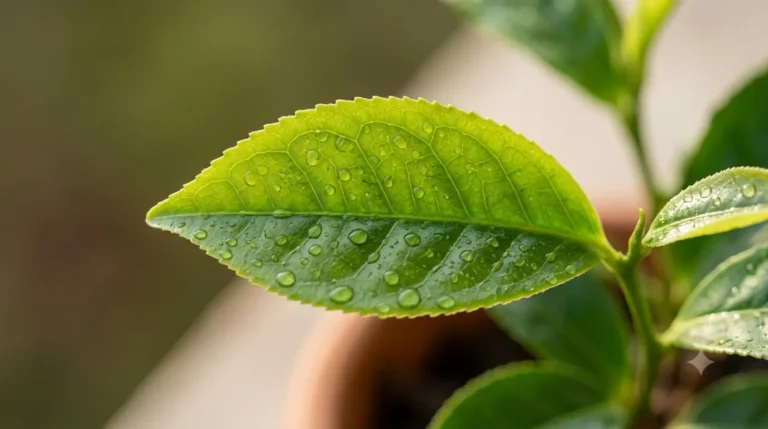
To unravel this mystery, we need to name the protagonist of this story: Camellia sinensis. It is a perennial plant, native to East and Southeast Asia, that thrives in subtropical and high-altitude regions. Botanically speaking, if the liquid in your cup was not extracted from the leaves or buds of this specific plant, it is not, technically, a “tea” — it is an herbal infusion (as is the case with chamomile, peppermint, or hibiscus).
The great magic of Camellia sinensis lies in its biochemical composition. Its leaves are incredibly rich in polyphenols, amino acids (such as L-theanine), and volatile compounds that react dramatically to oxygen, heat, and moisture. It is this sensitivity that allows tea masters to extract such distinct sensory profiles from the exact same raw material. What determines the final result is a controlled biological process called oxidation.

The Alchemy of Processing: From the Same Leaf to Six Types of Tea
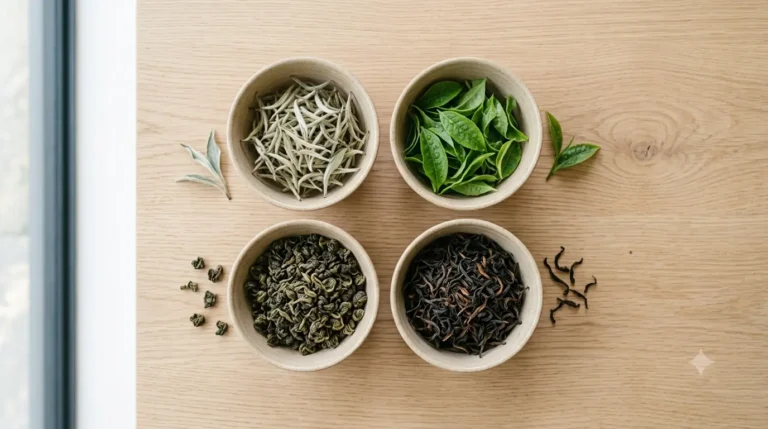
Understanding how leaves are processed means understanding the tea family tree. The way a producer handles the leaf after harvest defines its category, color, and medicinal properties. Let’s explore the main branches of this transformation:
- White Tea: The Purity of Buds
White tea is the least processed of all varieties. It is made almost exclusively from the plant’s young spring buds, which are simply sun-dried or dried in controlled environments. Because the leaves are not rolled or broken, oxidation is minimal. The result is a drink with a subtle, slightly sweet flavor that is rich in pure antioxidants.
- Green Tea: Stopping Time
To produce green tea, the goal is to halt oxidation immediately after harvest. To do so, the leaves are exposed to a heat source — either through steam (the traditional Japanese method, as in Sencha) or in heated pans (the traditional Chinese method). This heat deactivates the enzymes that would otherwise oxidize the leaf, preserving its vibrant green color, herbaceous flavor, and high catechin levels.
- Oolong Tea: The Balance of Complexity
Known as blue tea or semi-oxidized tea, oolong sits exactly halfway between green and black. The leaves are harvested, withered, and deliberately bruised or tossed to rupture their cell walls and allow for partial oxidation (ranging from 10% to 80%). It is one of the most complex categories, displaying notes that range from floral and creamy to toasty and fruity.
- Black Tea: Full Intensity
In the case of black tea (called red tea in China), the leaves undergo complete oxidation. They are fully withered, rolled, and left in warm, humid environments until they turn dark. This process transforms catechins into thearubigins and theaflavins, giving black tea its full-bodied, malty flavor and higher caffeine concentration.
Practicing Presence Through the Varieties
- The Delicacy of White Tea: Perfect for calm mornings or moments of introspection. White tea requires lower water temperatures (around 165°F / 75°C) to avoid scalding its delicate buds, and it invites a gentle, unhurried pace.
- The Calm Alertness of Green Tea: Excellent for focusing on work or study without the jitteriness of coffee. The combination of caffeine and native L-theanine in the green leaf stabilizes the mind and sharpens thoughts.
- The Sensory Journey of Oolong: Ideal for long afternoon mindfulness rituals. Its leaves are often rolled into small pearls that slowly unfurl with each steep, revealing new aromas in every cup.
Conclusion: Terroir and the Human Touch
Discovering that all true tea comes from Camellia sinensis makes us appreciate even more the concept of terroir — the combination of soil, altitude, climate, and the producer’s expertise. Just as in the world of wine, the same plant grown in the misty mountains of Taiwan will yield a completely different experience than one planted on the plains of India. The next time you enjoy a cup, remember the incredible biological journey that leaf has taken, and allow yourself to appreciate the human ingenuity that, from a single plant, managed to create an entire universe of colors, rituals, and well-being.
Sources and Inspirations
- Harney, M. (2008). The Harney & Sons Guide to Tea. Penguin. (A global reference on the botany of Camellia sinensis and the detailed methods used to process its leaves.)
- Heiss, M. L., & Heiss, R. J. (2007). The Story of Tea: A Cultural History and Drinking Guide. Ten Speed Press. (A comprehensive academic guide detailing the history, taxonomy, and chemical transformations involved in the varieties of tea.)
- Khan, N., & Mukhtar, H. (2013). “Tea and health: phytochemicals in tea and their modulation of cellular targets.” Archives of Biochemistry and Biophysics. (A scientific study analyzing the plant’s bioactive compounds and how oxidation alters their functional properties in the body.)
Continue Your Vitality Journey
- Why Is Tea the Second Most Consumed Drink on the Planet?https://thehealthliving.com/why-is-tea-the-second-most-consumed-drink-on-the-planet/
- The Countries That Consume the Most Tea:https://thehealthliving.com/the-countries-that-consume-the-most-tea-the-ranking-will-surprise-you/
Share Your Discovery: Did you already know that green, black, and oolong tea all come from the exact same plant? Which of these categories is your favorite to complement your daily routine? Leave a comment below and let’s talk about this wonderful botanical culture!
Transparency Note: This blog values originality and technology. The illustrations in this article were developed with the assistance of artificial intelligence to ensure a unique visual identity that is free of copyright restrictions.
