
ℹ️ Note: This article contains affiliate links. As an Amazon Associate, I earn from qualifying purchases at no extra cost to you.
If you drew a line on a world map, you would see an invisible border separating entire civilizations. On one side, the empire of explosive caffeine, urgency, and intense focus. On the other, the domain of serenity, longevity, and ancient tradition.
Why, well into the 21st century, do some countries remain immune to the omnipresence of major coffee chains and keep the kettle as the most important item in the home? The silence that speaks volumes here is that the choice between tea and coffee is rarely about flavor. It is about who conquered whom, where the sun shines hardest, and how each people decides to manage its vital energy. Understanding that choice means understanding the soul of each country.
The Colonial Legacy: Where History Was Written in Leaves
The number one reason for a nation’s preference is, more often than not, its past.
- The Silk Road and the British Empire: Countries that were directly influenced by Asian trade routes or the British Empire inherited tea as a social pillar. India, Pakistan, and Kenya are examples where tea was introduced as an export crop and ended up becoming the people’s drink.
- The Ottoman Empire: Turkey is the prime example. After the fall of the empire and the loss of coffee-producing territories (such as Yemen), the government encouraged tea cultivation along the Black Sea coast, as it was more economically viable. Tea became an act of patriotism.
Biology and Climate: The Adaptive Factor
Climate dictates what the body craves.
- Thermoregulation: In extremely hot and arid climates, such as the Sahara or the Middle East, tea — especially mint green tea or strong black tea — aids digestion and promotes controlled perspiration, providing a relief that coffee, being more dehydrating due to its concentration, simply cannot match.
- Pace of Life: Societies that value extended hospitality and unhurried negotiation prefer tea. You can drink five cups of tea during a conversation without the crash or the jitters that five shots of coffee would cause.
Economy and Accessibility: The People’s Drink
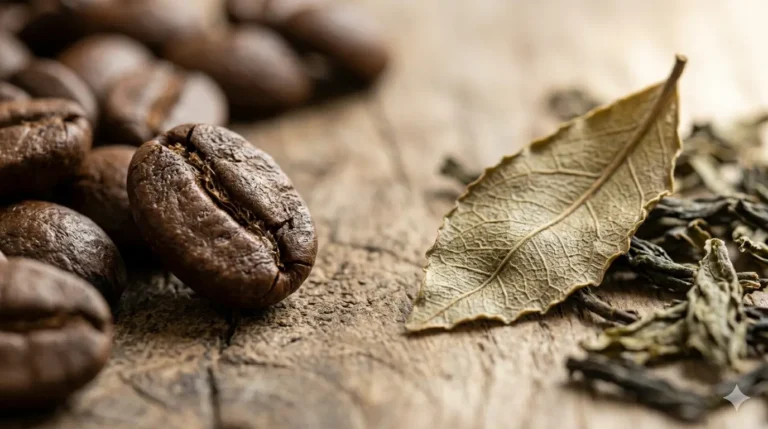
In many of the countries that lead in tea consumption, economics plays a crucial role. Tea is “volumetric” — with just a small amount of leaves, you can produce liters of drink. Furthermore, Camellia sinensis grows in a wider variety of soils than arabica coffee, which is highly sensitive. This makes tea the world’s most democratic drink: it belongs equally in the palace and at the street stall, with the same level of dignity.
Health and Philosophy: The Concept of Longevity
In countries like Japan and China, the preference for tea is philosophical. Tea is viewed as a medicine. While coffee is often associated with “work and productivity,” tea is linked to “health and mental clarity.” The presence of catechins and L-Theanine creates a wellness profile that aligns perfectly with Eastern philosophies of balance and disease prevention.

Choosing Your Identity
As your guide, I challenge you to observe your own routine. Do you drink coffee out of necessity and tea for pleasure? Or is it the other way around?
The Transition Ritual:
- The Warrior’s Morning: If your country or your routine demands immediate focus, coffee has its place.
- The Sage’s Afternoon: Try replacing your afternoon coffee with tea. Notice how your anxiety eases and your patience for handling challenges grows.
- The Observer’s Evening: Conclude that, regardless of global rankings, the best country in the world is the one you inhabit when you are fully present in your cup.

Conclusion and Next Steps
The preference for tea over coffee is a mosaic of history, cost, and biology. Countries that drink more tea have chosen a pace of life that favors consistency over intensity.
Further Reading
- The True Origin of Tea:https://thehealthliving.com/the-true-origin-of-tea-between-ancient-legends-and-the-revelations-of-modern-archaeology/
- Who Discovered Tea?https://thehealthliving.com/who-discovered-tea-the-fascinating-journey-of-the-pioneers-who-revealed-the-secret-of-camellia-sinensis/
Sources and Inspirations
- Oxford University Press: Food and Culture: A Geographical Perspective.
- National Geographic History: The Great Tea and Coffee Divide.
- Harvard Health Publishing: Comparative analysis of caffeine and L-Theanine in global beverages.
And what about you? If your palate were a country, would it be ruled by tea or coffee? Share your thoughts in the comments and let’s debate these different energies!
Transparency Note: This blog values originality and technology. The illustrations in this article were developed with the assistance of artificial intelligence to ensure a unique visual identity that is free of copyright restrictions.
