
ℹ️ Note: This article contains affiliate links. As an Amazon Associate, I earn from qualifying purchases at no extra cost to you.
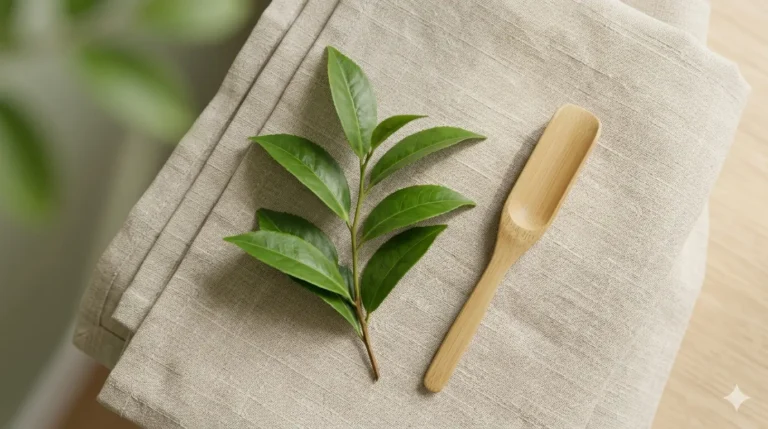
Imagine yourself in China in 2737 B.C. The wind blows gently across the mountain slopes as Emperor Shennong — known as the “Father of Agriculture” and Chinese medicine — rests under a tree. Careful about his health, he boils water to drink when, by a whim of nature, a few wild leaves fall directly into his pot. The water takes on an amber color and an invigorating aroma, and upon tasting it, the emperor feels an immediate mental clarity.
But did that cup of tea ever really exist — or is it simply a sip of historical poetry?
For those of us who seek balance and value daily rituals, understanding the origin of tea is more than an intellectual exercise; it is a way of honoring one of humanity’s greatest wellness micro-habits. In this article, we’ll separate myth from fact, exploring how modern science is finally confirming what the ancient sages already knew.
The Founding Myth: Shennong and the Divine Leaf
The legend of Shennong is the cornerstone of tea culture. It is said that he had a transparent abdomen, which allowed him to observe how each plant reacted inside his body. He is said to have catalogued hundreds of herbs, many of them poisonous, and tea would have emerged as the ultimate antidote.
Why does the legend of Shennong still resonate today?
Although the image of an emperor with a crystal belly is purely mythological, the concept behind the story is deeply relevant today. It reflects the discovery of tea not as a leisure drink, but as an herbal medicine tool. When you choose a green tea after a heavy meal, you are, in a way, replicating Shennong’s ancient experiment. Tea was born out of humanity’s search for healing and purity.
Beyond the Clouds: What the Documented Historical Record Tells Us
If we set aside the mist of myth and look at written records, the history of tea becomes a narrative of social and spiritual evolution.
For centuries, tea was not steeped the way we do it today. During the Zhou Dynasty (1046 B.C. – 256 B.C.), the leaves of Camellia sinensis were boiled together with grains, spices, and salt, forming a kind of medicinal soup or energy tonic.
The written record and the shift toward pleasure
It was only during the Han Dynasty that the specific term for tea began to take hold. Before that, it was often lumped together with other bitter herbs under the name tu. The transition of tea from “bitter remedy” to “pleasurable drink” was driven by China’s intellectual elite, who saw the mental clarity provided by theine (tea’s caffeine) as the perfect state for meditation and poetry.
Archaeology Steps In: Concrete Evidence
For a long time, skeptics argued that the origin of tea before the common era was purely literary. However, in 2016, a discovery at the mausoleum of Emperor Jing of Han, in Xi’an, changed everything.
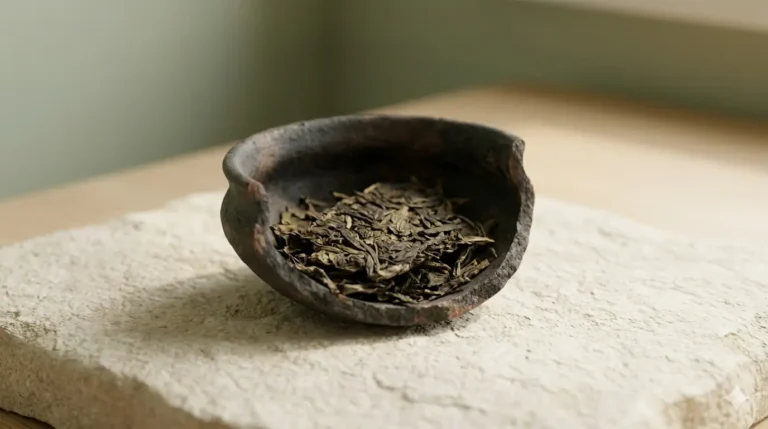
Archaeologists led by Dr. Houyuan Lu, of the Chinese Academy of Sciences, found carbonized traces inside a royal tomb dating back to approximately 141 B.C. Through sophisticated chemical analysis (mass spectrometry), scientists identified phytolith crystals that could only belong to the Camellia sinensis plant.
What does this prove?
This discovery, published in the journal Scientific Reports (Nature), is physical proof that tea was already a luxury item of great ritual importance more than 2,100 years ago. More than that: the analysis showed that only the youngest buds were used, indicating that a refined harvesting technique and a discerning palate for quality already existed at the time.
The Evolution of the Ritual: Lu Yu and the “Classic of Tea”
No history of tea’s origins would be complete without mentioning Lu Yu. In the eighth century, during the prosperous Tang Dynasty, he wrote the Cha Jing (The Classic of Tea).
Lu Yu was the first to systematize everything: from where to grow tea to the quality of the water and the ideal temperature of the fire. He transformed the act of drinking tea into an art form and a spiritual practice, strongly influenced by Zen Buddhism. For Lu Yu, tea symbolized the harmony between man and nature. This is where tea stops being just a plant and becomes a way of life — the concept of the “Way of Tea.”
Conclusion: Why Does the Origin Matter?
Whether tea fell into an emperor’s pot or was cultivated by anonymous farmers in the mountains of Sichuan doesn’t change the flavor of the drink — but it does change our connection to it. When you hold your cup, you are holding millennia of history, science, and spirituality.
Tea is the link between the ancient and the modern. It is the micro-habit that allows us to pause the chaos of the world for a moment of reflection.
References and Scientific Basis
To ensure the accuracy of this content, our research is grounded in high-authority sources:
- Dr. Houyuan Lu et al. (2016): Study “Earliest tea as direct evidence for ancient trade routes into Tibet,” published in Nature Scientific Reports.
- Lu Yu: Classic work The Classic of Tea (English translation by Francis Ross Carpenter).
- Sarah Rose: Author of the acclaimed book For All the Tea in China, which details the history and botanical espionage surrounding the plant.
- UNESCO: Recognition of China’s traditional tea processing techniques as an Intangible Cultural Heritage of Humanity.
Suggested Further Reading
- The Great Tea Odyssey:https://thehealthliving.com/the-great-tea-odyssey-how-a-chinese-leaf-crossed-oceans-and-conquered-the-world/
- Who Discovered Tea?https://thehealthliving.com/who-discovered-tea-the-fascinating-journey-of-the-pioneers-who-revealed-the-secret-of-camellia-sinensis/
And what about you — is tea more of a spiritual ritual or a health tool? Share in the comments which of these stories surprised you the most!
Transparency Note: This blog values originality and technology. The illustrations in this article were developed with the assistance of artificial intelligence to ensure a unique visual identity that is free of copyright restrictions.
