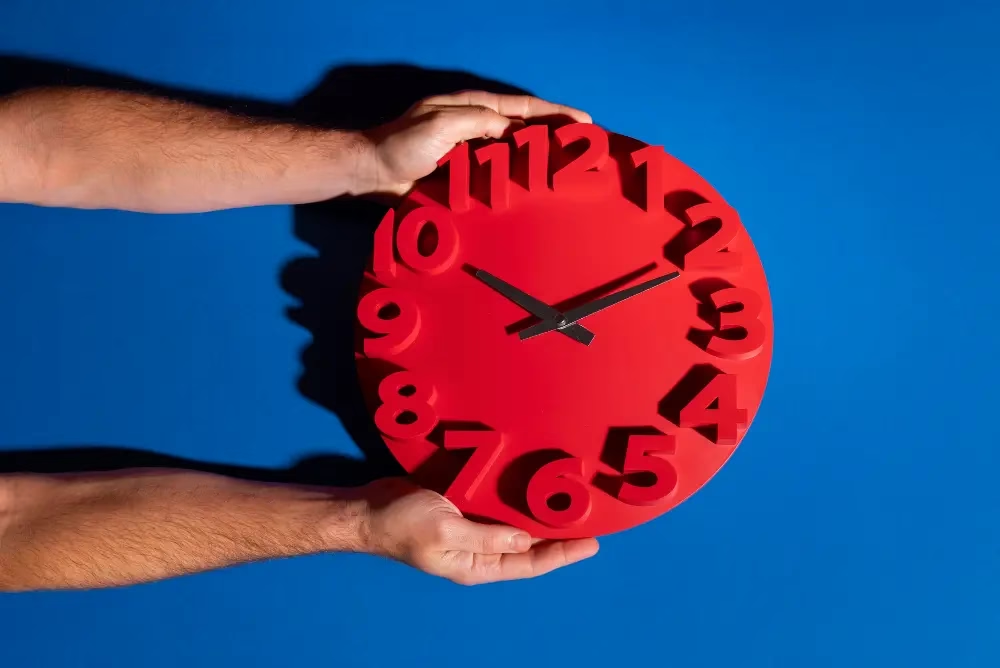
Have you ever felt like time seems to slow down when you’re nervous or fly by when you’re having fun?
This common feeling goes far beyond a simple “impression.” According to recent neuroscience research, your heart plays a direct role in how you perceive time—and this discovery is transforming our understanding of the relationship between body, mind, and emotions.
Prepare to understand how every beat of your heart may literally be molding your experience of the world.
The Scientific Revolution: Time Is a Bodily Experience
For a long time, time perception was believed to be a purely cerebral function. However, neuroscientist Irena Arslanova, from Royal Holloway University of London, has shown that the heart also acts as an “internal clock,” influencing how we sense the passing of seconds and hours.
According to Arslanova, the brain and body form an integrated system—and separating one from the other is like trying to understand a symphony by only hearing the sound of the conductor, without the instruments.
👉 In other words: we perceive time not only with the mind, but with the entire body.
The Experiment That Changed Everything
To test this idea, Arslanova’s team conducted an innovative study with 67 volunteers, monitoring their heartbeats while presenting visual and auditory stimuli at different moments of the cardiac cycle.
How the study worked
- Systolic phase: when the heart contracts and pumps blood.
- Diastolic phase: when the heart relaxes before the next beat.
Participants saw images or heard sounds during one of these phases, and then estimated the duration of each stimulus.
What they discovered
The results were surprising:
- When the stimulus occurred during the heart’s contraction, people perceived it as shorter than when it occurred between beats.
👉 This shows that your heart acts as a biological metronome, adjusting the way your brain processes time with every pulse.
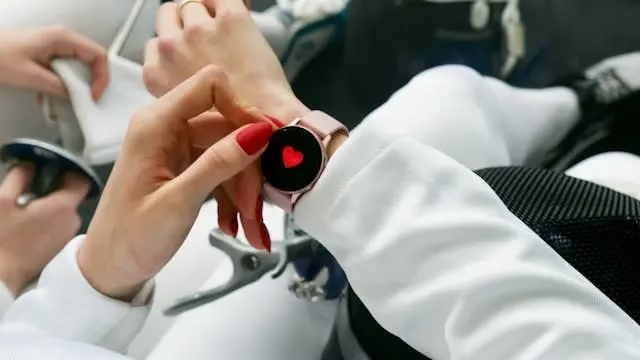
How Your Heart Creates Your Temporal Experience
The discovery revealed that the brain alternates between two states synchronized with the heart rhythm:
🩺 Active Mode (during heart contraction)
- Greater focus on action and response.
- Time “speeds up” in perception.
- More direct information processing.
🧠 Perceptive Mode (between beats)
- Increased sensory sensitivity.
- Time “expands” in perception.
- More detailed and reflective processing.
These two states alternate hundreds of times per minute, creating an invisible dance between heart and brain—and each person experiences this synchrony uniquely, depending on their natural heart rhythm.
When Emotions Change Your Internal Clock
Have you noticed that time seems to stop when you’re anxious, or fly when you’re happy?
Scientists also explored this emotional dimension, presenting emotion-laden images (scared, happy, neutral faces) during the experiment.
What happened
The more intense the emotion, the smaller the difference between the cardiac phases in temporal perception.
That is, when you are very anxious, in love, or scared, your “internal clock” tends to function more uniformly.
During these moments, the body enters a high-priority mode: the nervous system focuses entirely on the present, processing everything in real-time to deal with the situation.
Why Time Passes Differently in Different Situations
Based on these discoveries, it is possible to understand why time seems to “fly” or “drag” depending on the emotional and physiological context.
Situations that speed up time
- Working on something you love.
- Talking to someone inspiring.
- Being totally concentrated on an activity.
- Playing sports or music.
💡 In these cases, your brain synchronizes with your heart and reduces the perception of time—the famous “flow state.”
Situations that slow down time
- Waiting for important results.
- Feeling anxiety or fear.
- Being bored.
- Going through new or challenging situations.
💡 Here, the body broadens temporal perception to capture more details and increase the sense of control and safety.
How to Use This Discovery in Everyday Life
The good news is that you can learn to use your heart rhythm to your advantage, improving focus, well-being, and emotional balance.
- Increase your productivity with conscious heart rhythm
- Observe your pulse during different activities.
- Note at what moments you feel most focused.
- Plan important tasks during times of highest energy.
- Use deep breathing to adjust heart rhythm and regain focus.
- Manage anxiety and stress
- Try the 4-4 breathing technique (inhale for 4 seconds, exhale for 4).
- Synchronize your breathing with your heartbeats.
- Use meditation to increase body awareness.
- Create calming rituals that connect mind and body.
- Value leisure and the present moment
- Be fully present during pleasurable moments.
- Reduce distractions that “speed up” time.
- Use music and breathing to adjust your internal rhythm.
- Create “memory anchors” in special moments, recording the feeling of presence.
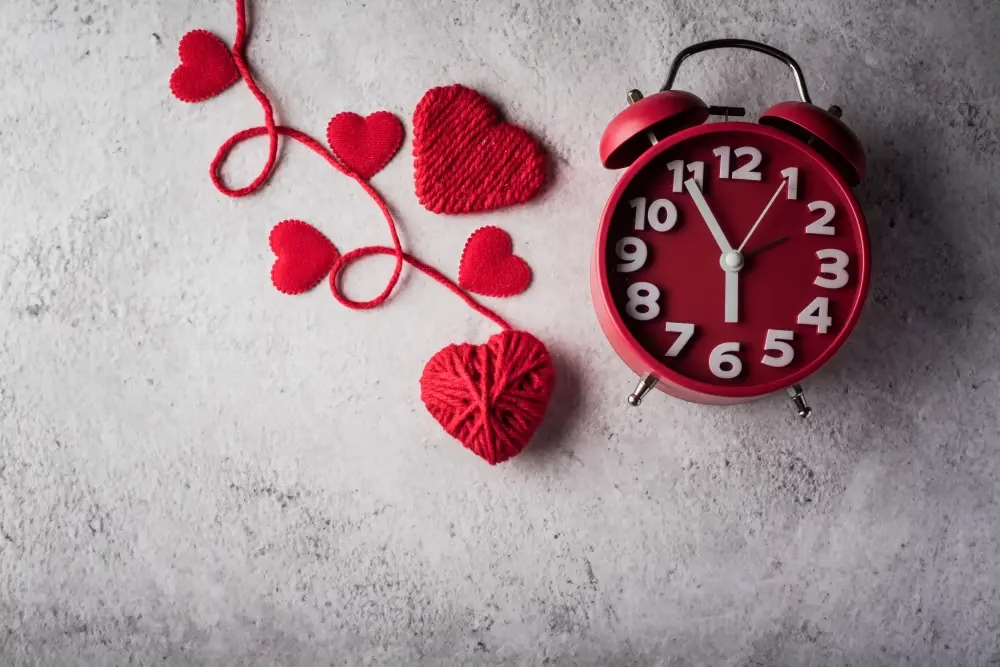
Heart, Mind, and Well-Being: A Deep Connection
This research reinforces what modern science has increasingly demonstrated: mental and physical health are inseparable.
Taking care of your heart is not just a matter of preventing cardiovascular diseases—it is also a way to regulate how you experience time and the world.
Habits that strengthen your internal clock
- Practicing aerobic exercises regularly.
- Having a diet rich in omega-3s and antioxidants.
- Sleeping between 7 and 9 hours per night.
- Managing stress consciously.
- Cultivating good social connections.
Practices that enhance temporal perception
- Mindfulness meditation.
- Yoga and Tai Chi.
- Breathing and relaxation techniques.
- Frequent contact with nature.
- Music therapy and rhythmic sounds.
The Future of Time Science: Medical and Technological Applications
Arslanova’s discoveries are inspiring new areas of research and innovation in health.
Heart rhythm-based therapies
- Treatments for anxiety and depression.
- Post-trauma rehabilitation.
- Mindfulness therapies in cardiac patients.
- Focus and performance training for athletes.
Emerging technologies
- Apps that synchronize activities with heart rhythm.
- Biofeedback devices for emotional balance.
- Virtual reality that regulates temporal perception.
- Personalized health protocols based on heartbeats.
These advancements show a future where medicine, psychology, and technology unite to harmonize body and mind in the same beat.
Practical Exercises to Train Your Temporal Perception
Want to explore your own relationship with time? Try these simple practices.
- Map your personal rhythm
- Measure your resting pulse.
- Do an activity for 10 minutes.
- Try to guess how much time has passed before looking at the clock.
- Compare and note the results in different emotional states.
- Heart-synchronized breathing (4-4-4-4 technique)
- Inhale for 4 heartbeats.
- Hold for 4.
- Exhale for 4.
- Pause for 4 heartbeats.
- Observe how your sense of time changes.
- Cardiac time meditation
- Sit comfortably and place one hand over your heart.
- Feel each beat and imagine it marking a unique moment.
- Observe how time seems to expand as you relax.
Reconnecting with Your Natural Rhythm
Understanding the connection between heart and time changes how we relate to life.
Instead of “fighting against time,” you can synchronize with it.
- 🌅 Mornings: Take advantage of the growing energy rhythm to plan and act.
- 🌇 Afternoons: Use focus and the flow state for creative tasks.
- 🌙 Evenings: Naturally slow down and allow the body to return to the perceptive mode.
Conclusion: Your Heart Is the Clock of Your Consciousness
Every beat of your heart is more than a sign of life—it is a marker of the subjective time that makes up your human experience.
When you connect with this internal rhythm, you discover that time is not your enemy, but your ally.
✨ Practice listening to your own heart.
✨ Perceive time not just with a clock, but with your body.
✨ Transform every beat into a reminder of presence and balance.
💖 “Now that you know the power of your heart over time, how about trying one of the breathing techniques and observing how your perception changes? Your body is your best clock—learn to listen to it.”
