
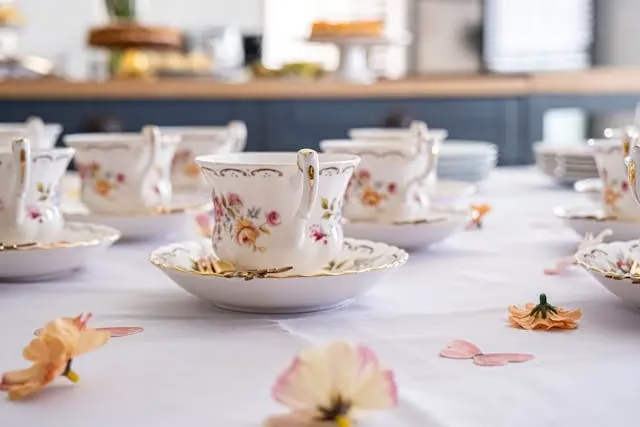
You just brewed a cup of tea.
As the steam rises and the aroma fills the room, someone in China did the same. And someone in India. And another person in Morocco, the UK, Japan, or Brazil.
All at the same time. Right now.
Tea is the second most consumed beverage in the world — second only to water. And when you stop to think about the actual numbers behind it, it’s truly impressive.
But Really, How Many Cups Are We Talking About?
Let’s get straight to the point.
The world consumes, on average, more than 3 billion cups of tea every day. That’s right: three billion. Every single day.
To give you an idea of the scale: if every cup were a person, you would have nearly half of the Earth’s population drinking tea simultaneously.
In terms of yearly volume, global consumption exceeds 6 million tons of tea. That’s a lot of leaves, a lot of hot water, and a lot of breaks throughout the day.
Who Are the Biggest Tea Drinkers on the Planet?
Asia dominates the game
It’s no surprise, but the numbers are staggering.
China is the world’s largest producer and consumer of tea. Over 1.5 billion cups are consumed by the Chinese alone every day. There, tea isn’t just a drink — it’s been a part of their cultural identity, hospitality rituals, and traditional medicine for millennia.
India comes in right behind. The famous chai — black tea boiled with milk, ginger, and spices — is almost like a religion in the country. It’s hard to find an Indian home where the day doesn’t start with a warm cup in hand.
The European surprise
You probably already know that the British love tea.
But how much? The United Kingdom consumes about 100 million cups a day. There is even a cultural expression called “tea time” — a moment of the day dedicated exclusively to sitting down, drinking tea, and taking a breath.
Seriously. Everything stops for a few minutes to have some tea.
What about Brazil?
Historically, Brazil is more of a coffee country than a tea country.
However, the tea market in Brazil has grown significantly in recent years. The search for wellness, healthy eating, and self-care rituals has caused tea consumption to explode on store shelves — especially herbal teas like hibiscus, chamomile, and green tea.
Brazilians are still far behind Asians in consumption, but the numbers are steadily rising.
Why Do So Many People Choose Tea?
It’s culture. It’s a habit. It’s a ritual.
In many countries, drinking tea is more than just hydrating the body. It’s an intentional pause. It’s a time to talk with family, welcome a friend, reflect before bed, or simply step out of “autopilot” for a few minutes. Tea has that power: it creates space.
The benefits help (a lot)
Of course, the effects on the body also play a big role.
Green tea, for example, is rich in antioxidants and is linked to better focus and a faster metabolism. Black tea contains caffeine and theophylline — great for starting the day with energy without the intensity of coffee. Chamomile is a classic for relaxing before sleep.
Every type of tea carries a promise. And the whole world seems to have found at least one that fits their routine.
The Most Consumed Types of Tea in the World
- Black Tea — The Global Champion: Accounting for about 75% of world consumption, black tea is the absolute favorite. It’s the base for Indian chai, British English Breakfast, and most of the iced teas consumed in the Americas. It has an intense flavor, dark color, and high caffeine content.
- Green Tea — The Health Favorite: Popular in China, Japan, and increasingly across the globe. Green tea saw a boom in the West during the 2000s and has stayed popular ever since. It became an ingredient in supplements, skincare, detoxes, and fitness menus.
- Herbal Tea — The Most Accessible: Technically, chamomile, peppermint, hibiscus, and fennel “teas” aren’t “real teas” — they are infusions. But the world calls them tea and drinks them just as much. In Brazil, these are the favorites for most people.
A Market That Never Stops Growing
The global tea market moves more than $200 billion a year, and the trend is only going up. With growing interest in health, wellness, and mindful rituals, more people are swapping sodas and processed drinks for tea.
The market for premium teas — those from a single origin, grown in specific regions with a story behind them — has grown especially among young adults looking for more authentic experiences.
A Sip of History
Tea has over 4,000 years of history.
Legend says it was discovered in China by accident when leaves from a tree fell into hot water being boiled by Emperor Shennong. He tasted it. He liked it. And the world was never the same.
From the Silk Road trade routes to feudal Japan, from colonized India to British parlors, tea spread across the globe — carrying culture, politics, and identity with it. Every cup you drink today has thousands of years of history inside.
Conclusion: Your Cup Is Part of Something Bigger
The next time you brew a cup of tea, remember:
At that exact moment, billions of people around the world are doing the same thing. One cup might seem small. But added together, they form one of the greatest human traditions in existence — crossing borders, languages, and generations.
Tea connects. It calms. It warms.
And now you know that you aren’t alone in this ritual.
What is your favorite tea? Tell us in the comments — and share this post with that person who always has a cup of tea in their hand!
