
When we think of the world’s largest tea producers, countries like China, India, and Sri Lanka usually come to mind. However, there is a true African giant that holds a prominent place in this global scenario: Kenya. Responsible for much of the tea consumed in Europe and various other markets, the country has transformed, in just over a century, into one of the most important powers in the tea industry.
What makes Kenyan tea such a valued product? How did it emerge in the country? Who is responsible for its production? And why has Kenya become a world benchmark, especially for black tea? In this article, you will discover in detail the impressive trajectory of tea in Kenya, its economic importance, its producing regions, its cultivation and processing methods, in addition to the growth of specialty teas that are winning over demanding consumers worldwide.
🌍 Kenya on the World Tea Map
Currently, Kenya ranks among the top three largest tea producers and exporters in the world, rivaling historical giants like India and China. The country not only produces on a massive scale but also stands out for its regularity, quality, and strong presence in the international market.
Tea is one of the pillars of the Kenyan economy and plays a strategic role in both job creation and the inflow of foreign currency. It is estimated that:
- The sector accounts for about 26% of national exports.
- It contributes approximately 4% of the Gross Domestic Product (GDP).
- It directly and indirectly employs millions of people.
This economic dependence shows that tea is not just a beverage for Kenya—it is a fundamental part of the country’s social and productive structure.
🕰️ The Arrival of Tea in Kenya: A Relatively Recent History
Unlike China, where tea has been cultivated for millennia, or India, with a centuries-old tradition, tea arrived in Kenya just over 120 years ago.
📍 First Cultivation in Limuru
Tea was introduced to the country in 1903, in the Limuru region, by European settlers, mainly British, during the colonial period. Initially, the cultivation was experimental, seeking to verify whether the African climate would allow the plant to thrive.
The results were so positive that, by the 1920s, commercial production began to expand rapidly, taking advantage of the extremely favorable natural conditions of the Kenyan territory.
🌱 From Experiment to Global Protagonist
Over the following decades, tea cultivation spread to several regions of the country. After Kenya’s independence in 1963, the government began to invest heavily in agricultural infrastructure, further strengthening the sector.
Today, in just over a century, the country has gone from zero to becoming one of the largest global tea powers—an impressive feat.
☀️ Why Is Kenya a Perfect Territory for Tea Cultivation?
The success of Kenyan tea is not by chance. It is the result of a rare combination of natural factors that create a practically ideal environment for the Camellia sinensis plant.
🌧️ Tropical Highland Climate
Although Kenya is located on the Equator, the main producing regions are in areas of higher altitude, which ensures:
- Milder temperatures
- High humidity
- Well-distributed rainfall throughout the year
This combination allows the tea to be harvested every month, something few countries can achieve with the same regularity.
🌋 Volcanic Soil Rich in Nutrients
Much of the plantations are situated on volcanic soils, which are extremely fertile and rich in essential minerals for the vigorous growth of the plants.
☀️ Abundant Sunlight
The proximity to the Equator provides Kenya with about 12 hours of sunlight per day all year round, which accelerates photosynthesis and contributes to healthier and intensely aromatic leaves.
The result of this combination is a tea with:
- Full-bodied flavor
- Intense color
- High concentration of bioactive compounds
- Excellent production yield
👩🏾🌾 Smallholder Farmers: The Backbone of Kenyan Tea
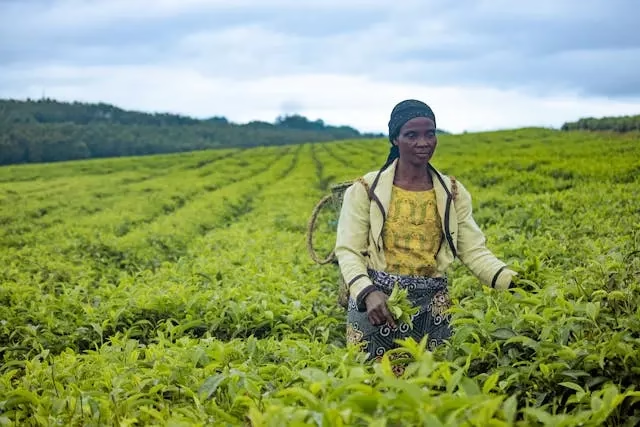
Despite the existence of large-scale production, the heart of the tea industry in Kenya lies in the hands of over 500,000 smallholder farmers. Most of them cultivate tea on properties of:
- Just 1 acre (about 0.4 hectare) or less
- Using family labor
- With production linked to cooperatives and regional factories
These producers are fundamental to sustaining the country’s impressive volume of exports.
🏢 The Role of the Kenya Tea Development Agency (KTDA)
About 60% of national production is coordinated by the Kenya Tea Development Agency (KTDA), one of the largest agricultural organizations in the world.
The KTDA:
- Organizes the collection of leaves
- Manages processing factories
- Offers technical assistance to producers
- Guarantees access to the international market
- Distributes profits cooperatively
Thanks to this model, Kenya has managed to combine productivity, organization, and social inclusion in the tea sector.
⚙️ The Predominance of the CTC Method in Processing
One of the most striking features of Kenyan tea is the predominance of the CTC (Cut, Tear, Curl) method in processing the leaves.
🔧 What is the CTC Method?
In this method, the leaves are:
- Cut
- Torn
- Mechanically rolled
This process generates small, uniform granules, ideal for:
- Tea bags
- Blends
- Large-scale production
About 90% of all tea produced in Kenya goes through this method.
☕ Characteristics of Kenyan CTC Tea
Kenyan CTC tea is famous for:
- Strong, distinctive flavor
- Dark, intense color
- High amount of caffeine
- Excellent resistance to milk and sugar
For this reason, it is widely used in blends consumed in the United Kingdom and much of Europe.
🌿 The Rise of Kenyan Orthodox and Specialty Teas
Although the CTC method still dominates the industry, in recent years Kenya has been undergoing a significant transformation with the growth in the production of Orthodox teas, also called specialty teas.
🍵 What Are Orthodox Teas?
These are teas produced with:
- A more artisanal processing
- Less mechanization
- Greater care for the leaves
- Emphasis on aromas, texture, and terroir
This type of tea is aimed at:
- Premium consumers
- Specialized tea houses
- Gourmet market
- High value-added exports
🏔️ Milima Tea: An Example of Excellence
One of the best-known examples is Milima tea, whose name means “high place” in Swahili. It is cultivated at over 6,000 feet (1,830 meters) of altitude, which provides:
- Slower growth of the leaves
- Greater accumulation of aromatic compounds
- More complex sensory profile
- More delicate floral and fruity notes
Today, teas like Milima position Kenya also in the segment of fine international teas.

🌎 Kenya in the International Tea Trade
The country exports the majority of its production, being one of the largest tea suppliers to:
- United Kingdom
- Pakistan
- Egypt
- United Arab Emirates
- Russia
- European Union countries
Kenyan tea is frequently used as the base for international blends, lending strength, color, and body to the mixtures.
Its strategic role means that Kenya directly influences global tea prices on commodity exchanges.
🌱 Sustainability and Environmental Challenges
With growing global concern for sustainability, the Kenyan tea industry is also investing in more responsible practices:
- Environmental and social certifications
- Reduction in the use of pesticides
- Reforestation programs
- Use of renewable energy in factories
- Emphasis on fair trade
However, the sector still faces challenges such as:
- Impacts of climate change
- Fluctuations in international prices
- Pressure on smallholder farmers
- Need for technological modernization
💪 Health Benefits of Kenyan Tea
In addition to its economic importance, Kenyan tea is highly valued for its health benefits, thanks to its high concentration of bioactive compounds.
Among the main benefits are:
- Strong antioxidant action
- Stimulation of metabolism
- Increased energy due to natural caffeine
- Improvement of cardiovascular function
- Aid in concentration and mental focus
As an intense black tea, it is especially appreciated by those seeking a stimulating and full-bodied beverage.
🔮 The Future of Tea in Kenya
Kenya is currently experiencing a moment of transition in the tea industry. While maintaining its strength in large-scale production, the country is increasingly betting on:
- Controlled origin teas
- Artisan production
- Valorization of the terroir
- New agricultural technologies
- High value-added exports
This diversification tends to make the sector even more resilient against changes in the global market.
✅ Conclusion: Why Is Kenyan Tea So Important in the World?
The trajectory of tea in Kenya is one of the most impressive in the recent history of world agriculture. In just over a century, the country went from beginner status to becoming a global power, moving billions, generating millions of jobs, and supplying homes across the planet.
With exceptional natural conditions, a strong cooperative model, mastery of the CTC method, and growth in the specialty tea segment, Kenya has consolidated itself as one of the pillars of the global tea industry.
Whether in a simple supermarket tea bag or in a cup of controlled-origin gourmet tea, there are very likely African leaves from Kenya in your drink. By savoring a strong, full-bodied tea, you may be tasting the result of more than 120 years of history, labor, and innovation.
